Showing posts with label hummingbirds. Show all posts

Tuesday, February 17, 2015

Rufous Hummers in Georgia

Genetics and migration are funny things.  Sometimes Genetics dictates what birds will do from how they sing to how they migrate.  For some birds, genetics determines what song a bird will sing.  Flycatchers for example have their songs programmed in their genetic code and some birds have their migration programmed into them.  If these things are programed in, that means they can changed and I had the opportunity to visit with a friend of mine and see evidence of this recently.  In the past few years, Rufous Hummingbirds have started to really take a hold in southeast as their wintering grounds.

The pictures you see below are a a male RUHU that has successfully made its home in Georgia.  As you can see, he's growing into quite the male with resplendent colors.  This bird is a tough little reminder of the how difficult migration can be and how birds are pushing their own limits.  The RUHU is a delightful bird to see and enjoy.  

As we approach migration, its important to remember to the increasing rigors that are facing our feathered friends as they attempt to race across our continent to get to their breeding grounds.  Until the next time, get outside!
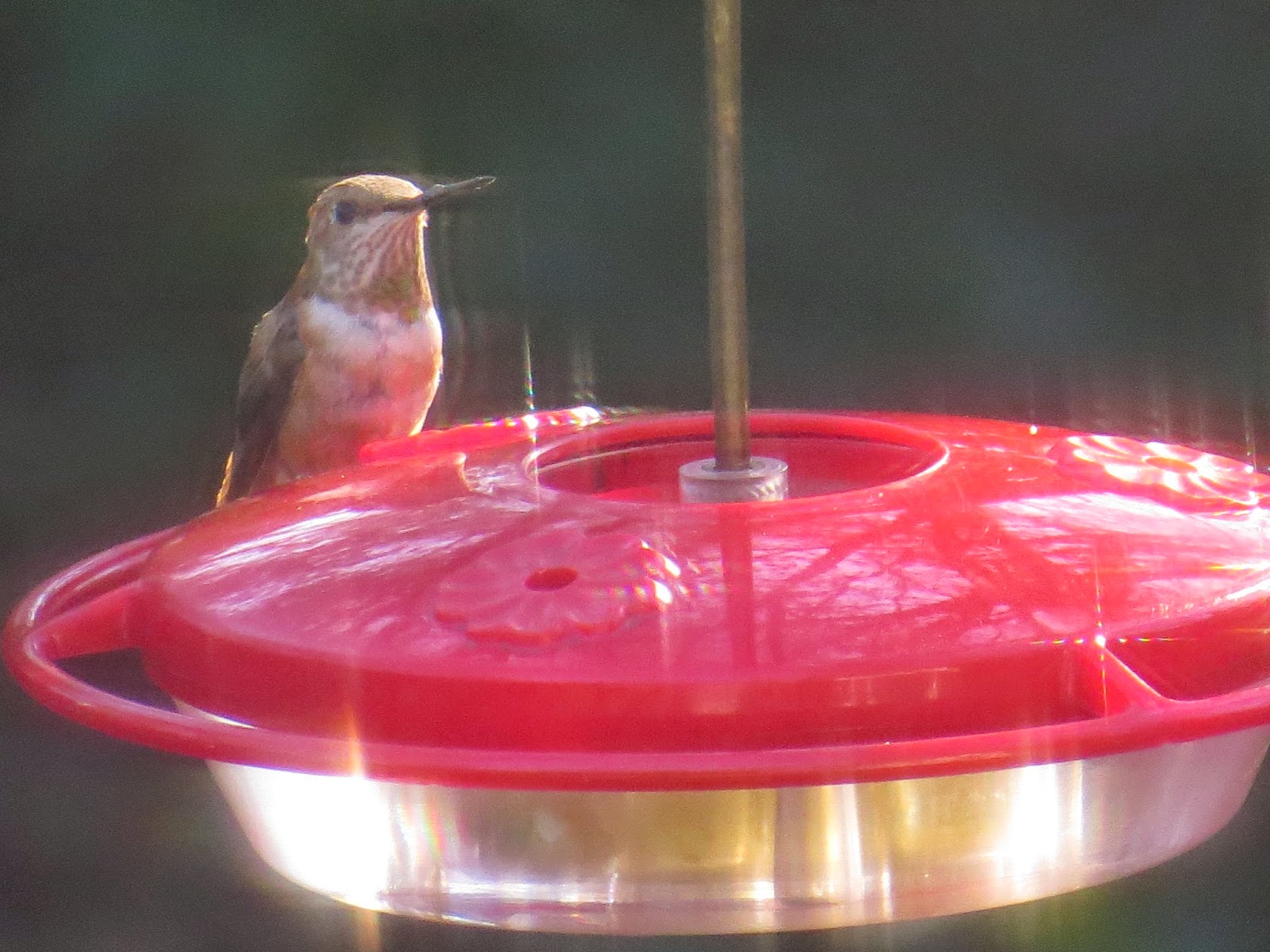
The Male Rufous at the Beginning of the Winter

Starting to show off his colors

Rufous Hummingbird - Link Here

Wild Bird Wednesday - Link Here

Sunday, July 6, 2014

Ruby Throated Entry

Put 2 paper clips in your hand.  This is the weight of your average Ruby-Throated Hummingbird.  Hummingbirds are pretty incredible birds.  But I don't have to tell you that.  You know how amazing they are.  The Hummers that zip around our gardens and parks spend their winter in Mexico and Central America.  How they make back and forth between their breeding grounds and their wintering grounds is a true feat of nature.  I was lucky enough to hear a UConn Grad Student in the Ornithology Department present on his findings regarding Hummes and their evolution.  There's a link below to his findings and they are extraordinary!

The talk focused on their tongues and beaks as tools to maximize their consumption of nectar.  In fact, most of the hummingbird seems to be geared towards getting the maximum amount of nectar.  Their flying agility is unparalleled but they are themselves very rigid.  Males leave females to care for the brood all on their own.  Females will build their nests near raptor nests to maximize protection.  Its worth nothing here that only 1 raptor is known to enjoy hunting and eating hummers, the Bat Falcon of South America.  Hummers are truly amazing animals!

What's your favorite Hummer experience?  Share in the comments below.  Until the next time, get outside and go birding!

Nature's Magic In The Air Documentary - Link here

UConn's Work on Hummingbirds- Link here


Ruby-Throated Hummingbird at All About Birds - Link here

Monday, November 18, 2013

A First for Connecticut

For a few weeks, Connecticut Birding experienced a first, a Black-Chinned Hummingbird.  While I had seen my first one of these beautiful birds in Texas in May, it was great to see one in CT and see this record BCHU.  This wonderful find turned up at a private residence and the owner was kind enough to let a number of birders see this record little fella.

Record birds represent an interesting facet of ornithology and bird migration.  How did the bird get here?  How is it surviving in a strange environment?  What is compelling it to stay?  Are we even sure this is a rare bird?  Not that I have any answers to these questions.  I think its worth reflecting on the voyage that this migrant has made before it leaves and hopefully returns to its flock.

That last one was inspired by what I always say when I see a rare bird.  Am I sure that's a rare bird?  For this BCHU, I am fairly certain that it is a rare bird.  Since it was a CT First I decided to fill out a Rare Bird Report Form.  Even if this form wasn't the best one, I really enjoyed the experience of filling out the form.  As a closing, I leave you with a selection from said form. Until the next time...

"Since CT is home to the Ruby-Throated that was the first bird that I compared the bird I found to.  The first thing that I noticed was the unusual chin markings and eye markings. The Chin markings are the ones that lead to me to verify that this is a BCHU.  They are clearly different from a RTHU and the photos match the descriptions found in Sibley’s Bird Guide. "


A Black-Chinned Hummingbird in Connecticut

Another View

In Flight and Feeding

A Real Joy to Behold, a Texas Treat in Connecticut