Showing posts with label open land. Show all posts

Thursday, February 13, 2014

Mind the Grassland Birds

One of the most troubled environments in the US and across the world are flat grasslands.  Why?  Grasslands are hard to maintain.  Grasslands are fertile spaces for growing and eventually trees colonize and take over.  This is of course a better alternative than when people buy the grassland and turn it into a development.  The Native Americans of the Southwest and other regions used to practice ritual burns of certain mesas to maintain the open grasslands.  Currently, open grasslands are threatened all over the world as people see them as easy spaces to convert into profitable projects.  That makes protecting them all the more important.

Every winter, we get Horned Larks visiting an opening grass parking lot in Hammonasset State Park.  I love finding these guys and seeing them fly around.  They have a great color scheme and super cool horns. Finding them in the open grass can be quite mercurial as they flutter, land, and often flutter again.  You have to look and understand the landscape and how it ebbs and flows before you can look for the birds.

Once you get a good feel for the land, you can find the birds.  Their motions will be easier to pick up once you know what's alive and fluttering instead of what's alive and being moved by the wind.  Grass after all is alive too.  Once you solve that, you can find yourself some Horned Larks and then some of the other residents of grasslands.  In the winter, that means Snow Buntings, Lapland Longspurs or other Longspurs.  In the Spring, Summer, and Fall, you can find migrating sparrows, Bobolinks, and Pipits.  Until the next time, get up and go outside!

Horned Larks in the open Grass

Can you find them???

A nice close-up

Easier to find them in the Snow!
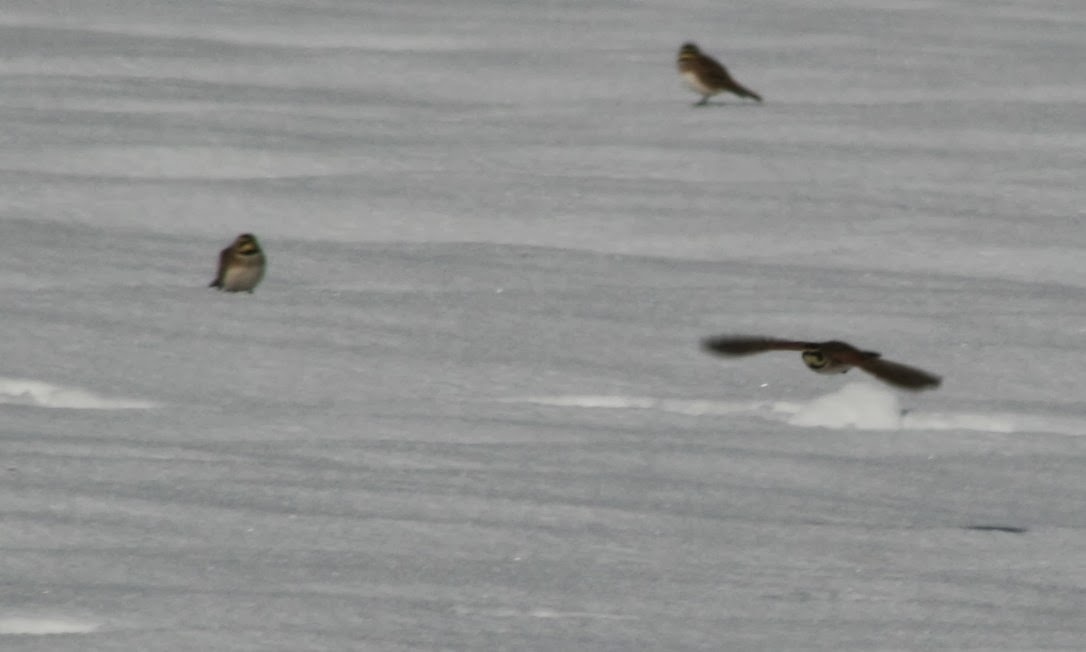
A shot of a Horned Lark flying

Horned Lark - Click Here

Monday, July 29, 2013

Birding a New Park

I had the pleasure today of birding a new park.  I don't mean that it was a new park for me, but a new park.  The land had once been a private airport, a developer's future project, and finally, a couple of soccer fields, a coastal forest, 2 ponds, and a few trails.  The park also benefits from being right against Hammonasset State Park which is an extremely important IBA in Connecticut and Southern New England.  This makes this new park a vital habitat.  I went to visit the park after a quick walk around Hammonasset.  At Hammo, I was able to grab a few great shots of Terns, Butterflies, and other birds.  But then I moved on to another park.

The opening of the new park was not the easiest process.  As I walked the park and heard from several people, many mentioned how difficult it was to secure the land.  The land was along Route 1, a major state route along the CT shore, and definitely was prime real estate.  When the land first became available, people wanted to make it a park, but then it was bought by a developer.  After zoning commissions and issues with the developer, it was the recession of 2008 that killed the prospects of the developer turning the land into condos.  While the Recession made developing less desirable, it took an alliance of Parks people, Conservationists, and towns people to make the park a reality.  Along with the natural spaces, there are plenty of people spaces as well.  While some will complain about the balance, I do appreciate any effort to get people outside as a good effort.  This is proof that good environments can be made to be friendly to all sorts of life.  I am also excited to visit this park to see how it develops and how the people and animals use.  So far, its been a success, 1 visit and 1 life bird, a solitary sandpiper!  Definitely enough to keep me going back for more!

Common Tern Adult and Juvenile at Hammonasset State Park
Eastern Black Swallowtail
Two Glossy Ibises and a Little Blue Heron
A Female Seaside Dragonlet
Spice Bush Swallowtail
A Solitary Sandpiper, Can you find it?

2013 Year List: 236
Solitary Sandpiper, latest Life Bird