Showing posts with label birding challenges. Show all posts

Sunday, January 5, 2014

A Good Start to January

So I set some lofty goals for 2014.  After 5 days, I have seen about 69 birds and I can't believe how strong by start has been.  I've gotten some great birds!  First was some great looks at a local snowy owl that's been showing off blocks from downtown New Haven.  I've had a real wealth of owls this year.  Snowy, Great Horned, Screech, and Barred have all found a place on to my year list.  I feel very lucky to have shared some space with this birds.  Definitely feeling the unicorn effect when it comes to these birds.

To start the year off, I've included some pictures of the Snowy Owl I got to see a few days ago.  The bird gave us great looks and we left it alone after a while.  After walking out onto a great pier and braving the wind, we noticed that the Snowy Owl was no more than 15 feet from the car.  Seeing such a beautiful bird is such an amazing experience.  After enjoying the bird, we quickly packed up and left.  We didn't want to alarm the several gulls and other birds in the harbor to see and then bother the Snowy Owl.

The Owl was hiding right by the parking lot

There's something going on with his eye, any ideas?

Life List: 327 (73 to go!)
CT Year List: 69 (156 to go!)
Goal Birds: None

Wednesday, October 30, 2013

Sparrow Me the Bird Puns

This Weekend was definitely sponsored by the Family of birds called Sparrows.  A couple of trips added a number of sparrows to my year list and even my life list.  Looking for and finding sparrows can be a great challenge for any birder.  Sparrow Identification can be fairly tricky and takes a great eye to distinguish between the different species.  Here are some of the keys I use for sparrow iding:

Breast Color and Streaking -  This can often be difficult to use depending on the glimpse.  However it is important to start distinguishing between clean breasts, streaking, dots and the differences in colors in those.  Remember that streaking can be messy, blotchy, fine or clean.  The Colors on the Breast can be tricky as often contrast can be minimal.  Finding the contrast can go a long way to

Beak - The key here is to look for the color of the beak and whether or not there is one or two colors.  Some sparrows have two colors in their beaks, some have light colored beaks and some have dark colored beaks.  Distinguishing the beak colors can help parcel sparrows apart.

Head - With this I am including the eye, even though some separate the two.  Learning how to id patterns and color of the head is essential.  Chipping Sparrows, White-Throated, White-Crowned, Golden-Crowned Sparrows all have unique heads and one can learn a lot by studying the heads and eyes of sparrows.  Of course, Vesper Sparrows are a famous for their eye ring and Clay-Colored Sparrows are also famous for their signature heads.

Tail -Long or Short, White or Dark, can help you distinguish between different kinds of sparrows.  Knowing how to look at the tail can be a useful tool to distinguishing between common and uncommon sparrows.

Obviously this isn't a scientific list.  This is just the process that I use when I look at Sparrows.  If anyone has any suggestions, I'd love to hear

An Immature White-Crowned Sparrow

Savannah and Song Sparrows

Lincoln's Sparrow, a lifer for me!

A Lark Sparrow, another lifer!


Here are some links to Sparrows by AllAboutBirds and Cornell Lab:
Song Sparrow
White-Throated Sparrow
White-Crowned Sparrow
Lark Sparrow

2013 Year List: 269
Notable Additions

Saturday, September 14, 2013

Why not, Red Knot?

There are few birds that capture the imagination like a Red Knot.  They travel awesome distances, gather in spectacular fashion, and embody a plight of all nature, dwindling numbers.  Many people will tell you that the Red Knot's story is dwarfed by others who also face the same struggle.  For me though, the Red Knot was one of the first birds to really understand their plight and their migration.  The Story of B95 is one that is widely well known and shows the great story of the Red Knot and other Shorebirds.

Shorebirds are amazing birds.  I don't think I need to sell many people on how amazing they are but its a good reminder and exercise to do so.  Red Knots were one of those amazing migrations that I had always wanted to see and witness.  It was a definite moment when I was hit with the unicorn effect when I found this Juvenile Red Knot.  I can't wait to see more of migration and hopefully more Red Knots.  I can't wait for the opportunity to try and chase some Red Knots in breeding plumage to round out my experience of them.  Until then..

Juv. Red Knot

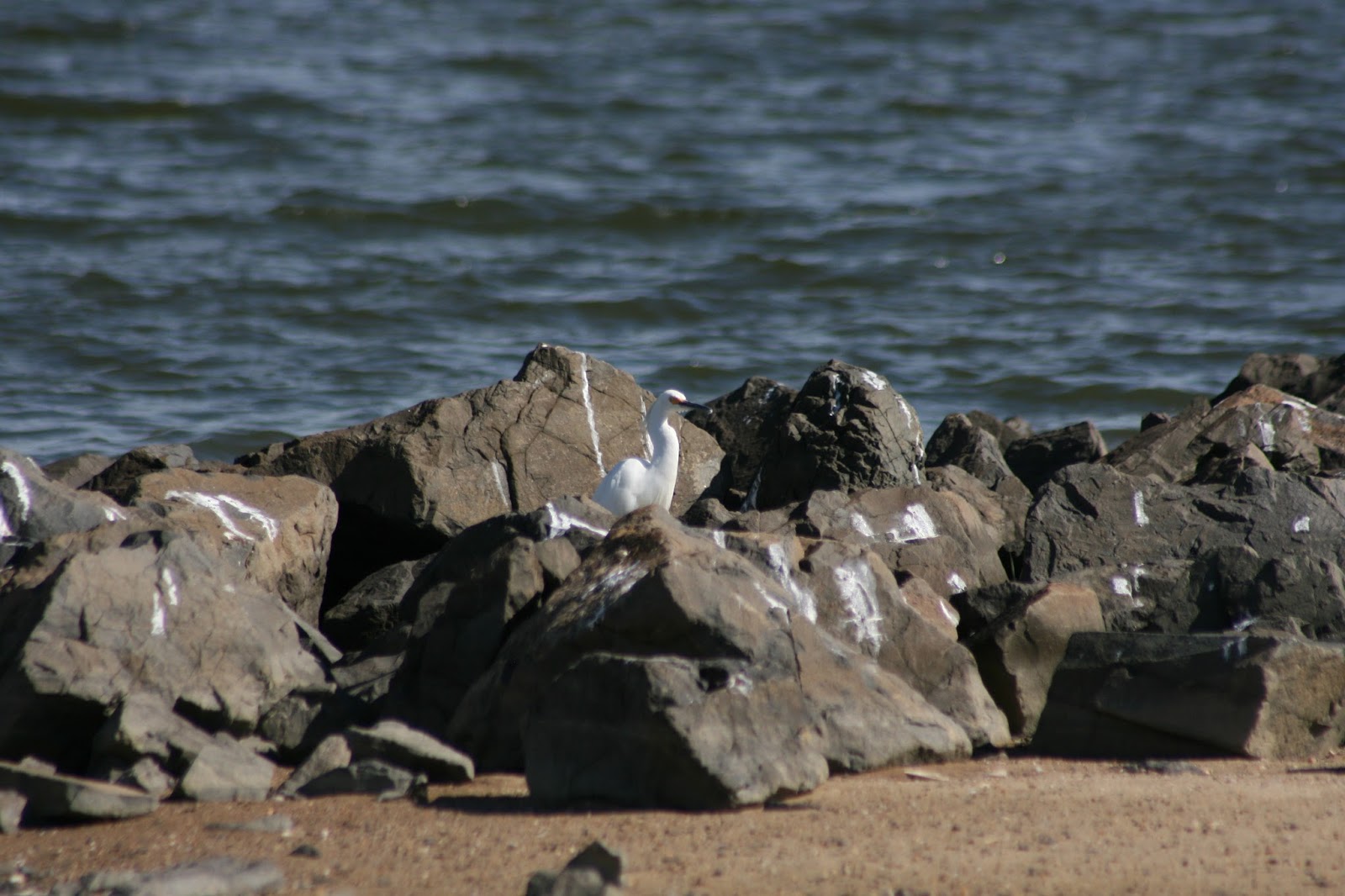
Snowy Egret Hiding in the rocks

Northern Waterthrush at Jamaica Bay

A Cicada

2013 Year Birds: 261

Coming Up:  More Fall Migration!  Hawk Watch!

Tuesday, May 21, 2013

Room to Spare


So this post has been a long time coming.  I've been working for a long time at becoming a better birder, naturalist, and outdoor enthusiast.  For this year, I set the goal of getting my life list up to 300 Birds and my Year list up to 200.  Its been slow going with my list and ebird has been a tremendous help.  Its helped me keep an excellent record of my birds and where I've seen them.  So I am pleased to announced that I've met both Goals.  My Life List stands at 307 and my Year List Stands at 216.

So here's an update of the Birds that got me over the hump:
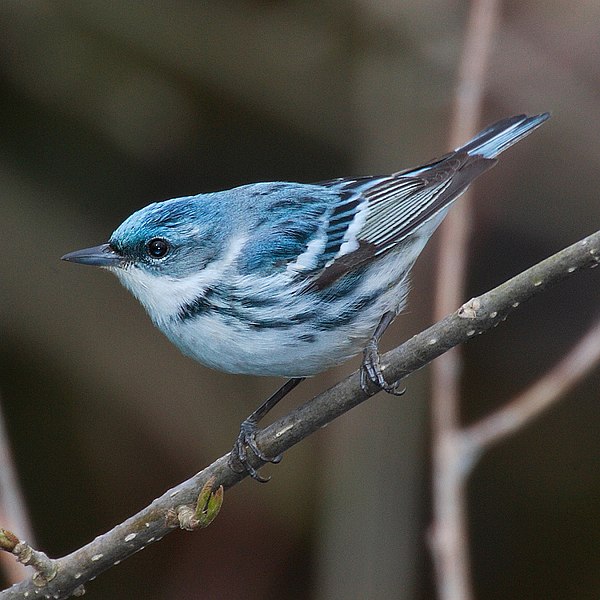
Cerulean Warbler
Veery
White-Eyed Vireo
And all the Texas Birds I got last weekend

File:Dendroica-cerulea-002.jpg
A Cerulean Warbler (C) Mdf
Veery (C) All about Birds - Cornell Lab of Ornithology
File:White-eyed Vireo by Alastair Rae.jpg
White-Eyed Vireo (C) Alastair Rae


Friday, April 26, 2013

First of the Year

When it comes to migration, there's a lot of pressure to see the first of the year.  To be the first to see something or record your first sighting of something.  Sometimes, these can be great moments.  The bird can be tired from their migration and just too hungry to really care who's around.  I saw my first House Wren of the season.  I was excited because it was the first of the year for me.  There's a lot of hype about the first of the year.  Everyone wants to see the first of the year birds and migration just makes the fervor even worse.  I don't want to sound self-righteous, I get caught up in the fervor.

Many write that birding is not unlike hunting.  The quest for the first of the year is indeed tied to the instinct to hunt.  Searching through the thicket, trees, and marshes, its a primal need and skill.  Being close to the earth in that way is amazing.  One of the main reasons I got into birding was to find a way to interact with nature beyond knowing the difference between a tree and a bush.  I wanted to understand something more about nature and certainly birding has changed the way I see my environs.

I will certainly keep looking for those FOYs.  I hope you do too!


What I was looking for...
Adult
(C) Gerry Dewaghe 
2013 Year List: 138 (62 Needed)
House Wren

Tuesday, April 23, 2013

Migration is Coming...

This is a a well known fact that spring is on its way.  Every day my phone lights up with bird alerts from around the state.  This makes for exciting outings.  Every time you go out, there's seems to be something new.  As the past week worked out, I saw all sorts of new birds and sights.  I've attached some pictures below from my travels.

I am hoping to get many more pictures of migrants as they pass through.  There are some impressive sights to be had.  At Bombay Hook, I have over 150 American Avocets.  Seeing Shorebirds move in and warblers move in really helps me to understand and appreciate the journey the birds make.  Migration is an amazing feat.  Well, enough writing and get outside!

Purple Martins
American Avocets
Blue-Winged Teal
Bass Spawning
Hermit Thrush
Carolina Wren

Friday, April 19, 2013

Birding with Legends

This week, I was birding with legends.  Well, Legend.  I drove down to the National Audubon Society Sanctuary at Mill Grove.  While a nice and very walk-able sanctuary, there is a hidden secret.  This site was Audubon's First home in the US.  You might call it the birthplace of American Birding, Conservation, and Environmentalism and there's definitely an argument to be made for that.  Audubon's prints and magnificent publication, The Birds of North America, has definitely changed the way Americans view their environment.  Its hard not to look at the book and its prints and find yourself getting lost in the blend of nature, science, and art and also realize how much our world has changed.  The center had up Audubon's prints of the Passenger Pigeon along with skins from the collections of local colleges.

Despite those changes, there are plenty of birds still around Mill Grove.  Carolina Chickadees, Cardinals, Hawks, Bluebirds, Swallows.  Its easy to see how a Young Audubon would have fallen in love with the natural world.  Also his future wife lived up the road so he would've had to climb through the grounds several times to see her.  But the variety of habitat makes this a great place to go birding.  There is a museum and exhibits about Audubon's life and work that is worth a visit as well.  Spending time following in Audubon's footsteps is a great way to reflect on the nature of birding and the future of birding, the environment, and conservation.

 A Northern Cardinal
 Eastern Bluebird
 Red-Tailed Hawk
Mill Grove

2013 Year List: 137 (63 to go!)
Forster's Tern (Lifer)
Black-Necked Stilt (Lifer)
Lesser Yellowlegs
Brown Thrasher
Purple Martin
American Avocet

Friday, April 12, 2013

Crossley Raptor Guide - A Review

Everyone seems to be writing a review of recently released Crossley's Raptor Guide.  So I thought I'd put my own 2 cents in.  The Guide's best aspects are its plates.  This is a continuation of the work in the Eastern Guide.  One of the things that I liked about the old guide were the plates that showed the birds in different aspects, lights, and perspectives.  I thought that would make the guide better would be comparison plates.  And Crossley, one up'ed me.  There are challenge plates.  These plates are great.  The questions they ask (because they come with answers!) help practice ID skills and learning about the birds.

The descriptions are excellent as well.  I would have liked to have seen more descriptions in the Eastern Guide, but that would have made the book huge.  My overall recommendation of this book is that it is excellent for hawk watching and encountering raptors.  In many ways, it seems to be the raptor version of the Shorebird book published so many years ago.  And I mean this as a compliment through and through.  The Crossley Raptor ID Guide is a great addition to any collection and to anyone who enjoys Raptors and the highlights of Fall Migration!


(C) Crossley Book and Princeton UP