Showing posts with label shorebirds. Show all posts

Tuesday, April 14, 2015

She sells Shorebirds

If you love shorebirds, the above picture can be very exciting to you!

Like most birders, I've been working on learning more and more about the different ways to distinguish shorebirds.  Going to the Georgia coast is a great opportunity to study shorebirds and other coastal birds.  Along with some great views of birds, I got a life bird and a life subspecies.

Western Willet (subspecies)

While the Willet currently remains as one species, there is evidences that there is very little overlap between the Eastern and Western Populations and they do live in very different habitants and regions throughout their life cycle.  Eastern Willets winters in South America and breeds on the Atlantic Coast.  The Western Willets, seen above, winter on the Gulf Coast and some on the south North Atlantic coasts and Breed in the plains of the West.  This makes these two subspecies very different from each other.  

The Willet @ All About Birds - Link here

Comparing the Songs of the Willet Subspecies @ Sibley Guides - Link here

Whimbrel - a Lifer for me

This Whimbrel was a life bird for me.  I seemed to always dip out on these guys in Connecticut, but at the Bloody Marsh in St. Simon's Georiga, I got lucky!  This guy was very affable and was even hunting around and eating a bunch while I watched him.  His distinctive beak made him easy to spot out along with the fact that the other birds there were Least Sandpipers and Killdeer.  He stuck out like a sore thumb!

The Whimbrel @ All About Birds - Link here

wWild Bird Wednesday - link here


Tuesday, September 23, 2014

Lakes in Georgia

I've been told that there are no native lakes in Georgia.  Almost all the one's you'll encounter are man-made in one way or another.  But as long as they have water, shoreline, and food, birds don't really care if your lake is man-made, accidentally made, or "organic."  Birds are opportunists like we are all are aren't going to pass up a food source just because it wasn't there before... although it may take them a while to find it.

I visited a local lake, Lake Hartwell.  It is managed by the Army Core of Engineers and has a lot of trails, picnic grounds, and water ramps.  Great places to find birds.  My visit there proved that very point.  We were greeted by a great number of birds, Canada Geese, Great Blue Herons, Blue Jays, Mockingbirds, Sanderlings, and other great birds!  I've included a link to the Lake and its grounds, as well as the local rules that must be followed!

Next Time, we'll visit the State Botanical Gardens, until then, Get out and Go Birding!

Links to Lake Hartwell - Link here

A Sanderling on a red shore

Gulf Fritillary

Bird Quiz #4: Post your Guesses in the comments!

Wild Bird Wednesday - Link Here

Tuesday, September 9, 2014

World Shorebird Day

This September 6th was World Shorebird Day.  Shorebirds have compelling life stories of epic migrations and making it across continents.  They are also a massively threatened group of birds who suffers from climate change and habitat loss.  I spent the day with the Atlanta Audubon Society with their Workshop on Shorebirds.  The Workshop focused on learning how to identify and age shorebirds by looking at their structure and learning the stages of molt.  After working on the our skills, we took to the field were we found Spotted Sandpipers, Lesser Yellowlegs, Least Sandpipers, Semipalmated Sandpipers, and even Semipalmated Plovers!

Now its time for a Bird ID Quiz.  What are the two birds below?  Can you age them?  Post your answers below.

Bird #1

Bird #2

American Oystercatchers flying about, not catching oysters

World Shorebird Day - Link here

Wild Bird Wednesday - Link here

Atlanta Audubon Society - Link here

Sunday, May 11, 2014

The Non-Warbler Special: Shorebirds

While warbler neck begins to strike the Birders of North America, other poor birds are ignored.  This tragedy can be reserved though.  Don't just look up, take some time and look down.  While walking a trail in a Connecticut Warbler Hotspot, I found a Solitary Sandpiper strutting around.  It was a great find for me in a park most noted for its warblers.

Its worth checking out a beach or two over the next few weeks.  Lots of birds will be using beaches to prepare for nesting and as staging grounds for migration.  They are important habitats for any number of species.  They are also hotly contested areas too.  Developers also see them as key habitats.  But that is a bit off topic.  Enjoy the Warblers and enjoy all the birds!

Happy Mothers Day and Go Birding!

Snowy Egret and a Yellowlegs!

Solitary Sandpiper

Silhouette of a Solitary Sandpiper

Saturday, September 14, 2013

Why not, Red Knot?

There are few birds that capture the imagination like a Red Knot.  They travel awesome distances, gather in spectacular fashion, and embody a plight of all nature, dwindling numbers.  Many people will tell you that the Red Knot's story is dwarfed by others who also face the same struggle.  For me though, the Red Knot was one of the first birds to really understand their plight and their migration.  The Story of B95 is one that is widely well known and shows the great story of the Red Knot and other Shorebirds.

Shorebirds are amazing birds.  I don't think I need to sell many people on how amazing they are but its a good reminder and exercise to do so.  Red Knots were one of those amazing migrations that I had always wanted to see and witness.  It was a definite moment when I was hit with the unicorn effect when I found this Juvenile Red Knot.  I can't wait to see more of migration and hopefully more Red Knots.  I can't wait for the opportunity to try and chase some Red Knots in breeding plumage to round out my experience of them.  Until then..

Juv. Red Knot

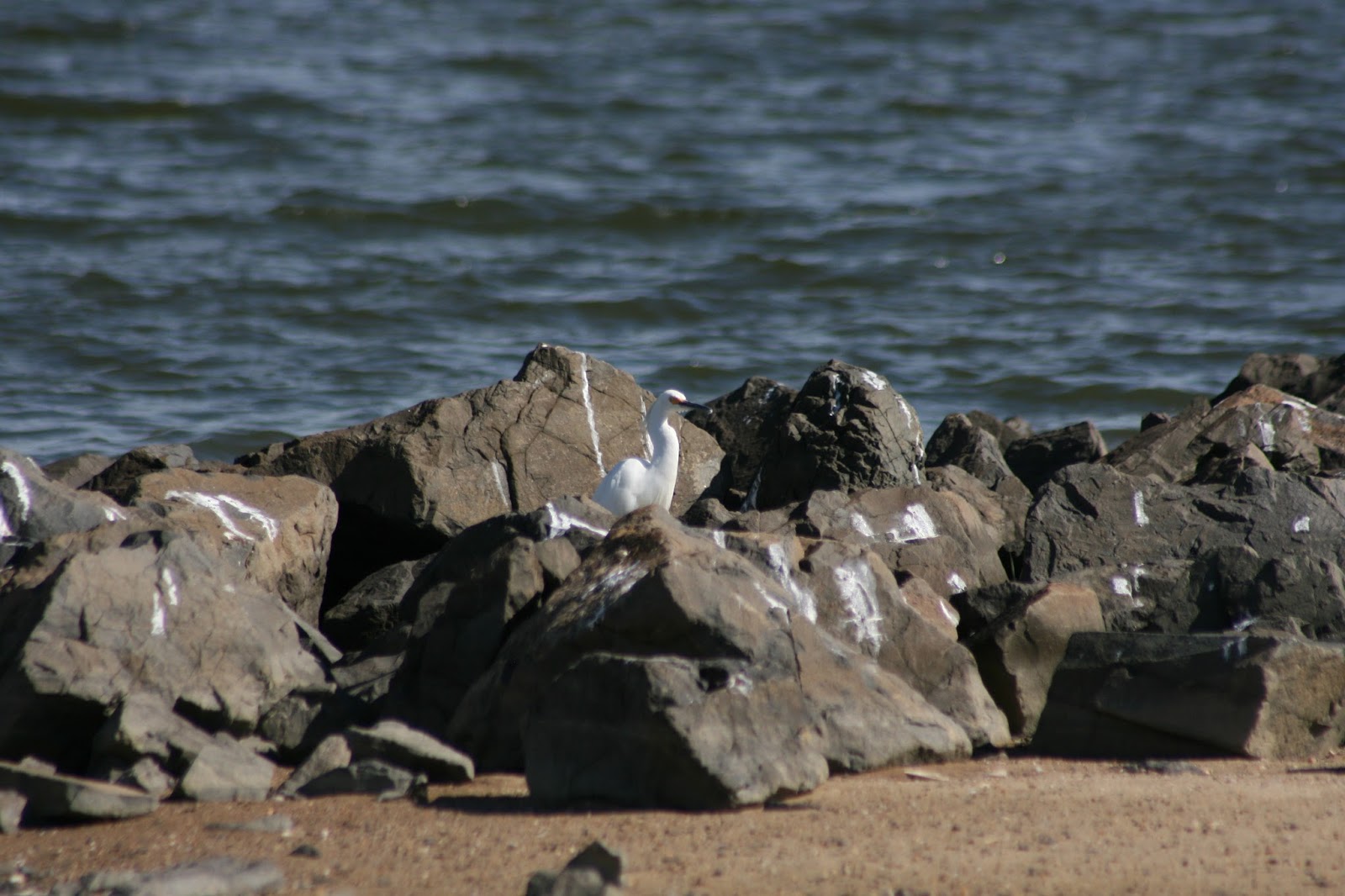
Snowy Egret Hiding in the rocks

Northern Waterthrush at Jamaica Bay

A Cicada

2013 Year Birds: 261

Coming Up:  More Fall Migration!  Hawk Watch!

Thursday, June 20, 2013

Black Skimmers

The Black Skimmer.  What an interesting bird.  In many ways so similar to a shore bird, but also so very different.  The Black Skimmer is black, white, and has a long orange and black bill.  Much like every other shorebird, until you get a look at their bill.  They are a strange looking bird.  One that makes you think you are just imagining them, that their long bills and unique behavior are just figments of your imagination.  They are however, very real and very awesome birds.  Connecticut is their most northern limit but there are a few nesting records here in the state.

Seeing them reminded me of the power of the Unicorn Effect.  When I heard about their being sighted in a near by site.  Being out in nature, provides any number of opportunities to be lost in it.  To be feel connected to it and feel its presence.  The Black Skimmer reminds me that I can reconnect myself to exotic nature in my own backyard.  Richard Louv, in Nature Principle, writes that "Near is the new far" and the Black Skimmer reminds me of this fact and that I re-live this again and again when I go outside!

All About Birds: Black Skimmer Link


All Photos (C) Me

2013 Year List: 227
Black Skimmer (308 Total)

Sunday, May 19, 2013

San Antonio Review

So I just returned from a trip to lovely San Antonio Texas.  I visited 3 sites dedicated to birding.  I've already written about the good work being done at the Botanical Gardens.  So I want to focus on 2 other sites.  Warbler Woods (http://warblerwoods.org/) and Mitchell Lakes Audubon Center (http://mitchelllake.audubon.org/).  Both offer an incredible habitat for birds and all sorts of animals.  I had a blast exploring the different habitats around San Antonio and could have gone back for more.  There were countless sites that I want to go back to and see.

Warbler Woods - This site is incredible.  Painted Buntings, Greater Roadrunners, Scissor-Tailed Flycatcher, and Canada Warblers were the biggest highlights of the site.  For the followers of my blog, You will note that both Scissor-Tailed Flycatcher and Canada Warbler were 2 of my Goal Birds for the year.  It was a marvelous site and one that I hope to return to in the future!

Mitchell Lake Audubon Center - This site has a plethora of habitat and is great for shorebirds.  The pictures below are from this site.  My highlight of this spot were getting great shots of the Scissor-Tailed Flycatcher, a Spotted Sandpiper, and an American Golden-Plover.  This was super awesome for me!  A goal Bird, a nemesis bird, and just a beautiful bird!  Time spent at Mitchell  Lake won't be a waste.

This post is short so I can get back outside.  Why don't we all do the same!

 Scissor-Tailed Flycatcher
 Yellow-Headed Blackbird
 Wilson's Phalarope
 American Golden-Plover *Goal Bird*
Hudsonian Godwit

2013 Year List: 199 (1 to go)
Life List: 297 (3 to go!)
Eared Grebe LIFER
American White Pelican LIFER
American Golden-Plover LIFER and GOAL BIRD
Hudsonian Godwit LIFER
Western Sandpiper LIFER
Baird's Sandpiper LIFER
Stilt Sandpiper LIFER
Long-billed Dowitcher LIFER
Wilson's Phalarope LIFER
Franklin's Gull LIFER
Black-chinned Hummingbird LIFER
Curve-billed Thrasher LIFER
Yellow-headed Blackbird LIFER
Inca Dove LIFER
Black-bellied Whistling-Duck LIFER
Western Kingbird LIFER
Common Ground-Dove LIFER
Greater Roadrunner LIFER
Common Nighthawk LIFER and ABA Bird of the Year
Scissor-tailed Flycatcher LIFER and GOAL BIRD
Canada Warbler LIFER and GOAL BIRD
Painted Bunting LIFER
Lesser Goldfinch LIFER
Neotropic Cormorant LIFER
Cave Swallow LIFER
White-winged Dove LIFER

Sunday, April 14, 2013

The Piping Plover

Imagine a beach.  What do you see?  Sand?  Obviously. A scattering of shells? Perhaps.  An endangered bird... maybe not so much.  But that's part of the problem.  We don't look for or expect anything at the beach other than sun and fun.  Perhaps that's been part of the problem.  We don't expect nature to be on our back door or in our parks or on our beaches.  Real Nature, the kind Hobbes describes or the kind we see on National Geographic, seems to be far away or locked in the deep forests of the inner continental wilderness.

Sadly not true.  Along the Beaches and coastlines of the Eastern US there is an endangered bird that needs your help.  The Piping Plover.  You can do some simple things to help:

  1. Don't leave any trash on the beach.  Trash attracts a larger than normal number of gulls and gulls can eat the Piping Plover. 
  2. You can not play or quiet the music you bring to the beach.  This scares the Piping Plover from eating and if it can't eat, it can't survive.
  3. Don't ignore warnings about breeding areas on the beach.  Disturbing sensitive breeding areas can lead to abandoned nests.
  4. Go out and look for the birds!  Seeing them in their habitat can lead to a great appreciation of the bird, its part in the ecosystem, and the beach itself.  The Beach, not just for tanning anymore!


(C) Me

2013 Year List: 121
Piping Plover
Eastern Towhee
Yellow Warbler
Northern Gannet
Glossy Ibis

Saturday, April 6, 2013

Don't Mess with my peeps

And by peeps I mean shore birds.  I've read, and re-read The Shorebird Guide and hoped that it would help me with the difficult task of distinguishing different shorebirds.  Sadly, this is not the case.  The Song of the Shorebird is intricate, subtle, and puzzling.  Which means for some birders the task of sorting shorebirds is a exciting as anything else.  Shorebirds are awesome.  They migrate massive distances, live in conditions that humans can only take for a few months of the year.

So in honor of shorebirds.  I've posted 3 pictures of flats that shorebirds love.  Make your guesses as to what you see below.  Enjoy the challenge!

Picture #1
 Picture #2
 Picture #3

Leave your guesses in the comments below!

Sunday, February 17, 2013

Barnacle Goose - Found!!

With Saturday free and my dog relaxed and in bed sleeping, I decided to spend the day out chasing rarities and even ventured to New Jersey to chase a couple of very rare birds.  As the readers of this blog will know, the Barnacle Goose has been a bird that I've spent many hours looking for the Barnacle Goose.  I am now happy to say that after days of staring at hordes of Canada Geese, I can now say that I've finally seen my first Barnacle Goose!  I showed up at a dam pond in New Rochelle, NY where there were rumors of one.  By rumors I mean eBird reports.  The Park where I found the Barnacle Goose was full of birds, 2 Pileated Woodpeckers, Red-Bellied WPs, Gulls, Chickadees, and Cardinals.  When I finally got to the pond, I was confronted by a Great Black Backed Gull eating the remains of a Canada Goose, a couple of Hooded Mergansers, and

The other rarity I chased was a Northern Lapwing in New Jersey.  While the Birders were out in force, finding the Lapwings was no easy task.  Before we found them, we found Blue Jays, Sandhill Cranes, and some aggressive Turkey Vultures.  It was the aggressive Turkey Vultures that rustled up the Lapwings.  There were about 3 of them far in the back of the field hanging out with some killdeer.  It was a great day to be out and about and to catch all those rarities was quite a treat!  Anyway, go outside and see some birds!


A Great Black Back Gull eating the leftovers of a Canada Goose (C) Me

A Pileated Woodpecker (C) Me

The Found Barnacle Goose (C) Me

2013 List: 73 (127 to go!)
Notable Additions:
Northern Lapwing (Lifer)
Barnacle Goose (Lifer)
Bonaparte's Gull
Merlin
Sandhill Crane

Life List: 258 (42 to go!)

Wednesday, January 16, 2013

Shorebirding... sorta

Since nabbing the Northern Saw-Whet Owl, I made a return to see some shorebirds and other birds.  There was a good variety of birds and I did spend most of the weekend outside looking for birds.  Which is of course my favorite way to spend a weekend.  I managed to see some old favorites and get some great new birds for the year!  The highlight was watching a Sharp-Shinned Hawk attack and devour a chipmonk.  Pretty cool to see.  The hawk had to navigate some through some bushes and hedges to chase down its prey.

Great weekend of birding and many more to come!

File:Anthus-rubescens-001.jpg
An American Pipit (C) Jonathan Hornung


Life List - 256 (44 to go!)
2013 List - 50 (150 to go!)

Notable Sightings:
American Pipit
Rusty Blackbird (lifer too!)
Lapland Longspur
Snow Goose

Friday, January 4, 2013

Christmas Life Bird

So, I decided to take a break from owling (for now) and went looking for some shore birds.  I visited some local ponds after X-mas breakfast.  I was looking for a local Wilson's Snipe that had been reported.  I never had much luck with birds like Snipes and Woodcocks.  I got my first Woodcock earlier in the fall and I was excited that the prospect of another worth ducking out of some holiday activities to see the Snipe.  (video below)  I took my dad out with me and he's a beginning birder.  So we talked a bit as we searched and scanned the grasses along the pond.  We found nothing at first, but decided to walk around the park to see what we could find.  Of course at that moment the Snipe flys off!  He's was right below us the whole time.  Fortunately, I was able to re-locate him and take the video below.  The wind was cold that day, but it was worth it to get this bird.

I ended 2012 with a good year in birding.  My life list topped out at 254 and I am looking forward to improving my skills and getting to enjoy more of nature.  I'll have another post on about my 2013 goals.  So for the moment, enjoy scenes from the life of a Wilson's Snipe!


Saturday, October 13, 2012

Fall Migration!

A visit to Hammonasset was supposed to yield rare and random seabirds.  No seabirds minus the Double Crested Cormorants that are prepping for their migration.  While the seabirds were disappointing, the rest of the day was incredible.  Birds were literally dripping from the sky... or bouncing around on the ground.  The Life Birds I got were: Orange-Crowned Warbler, Golden-Crowned Kinglet, Blue-Headed Vireo, Black-Throated Blue Warbler and the Elusive Marsh Wren!  It was a great to be outside and birding!

On another note, it had been a while since I had such a good time meeting and encountering other birders.  Not that other birders are rude, most follow the rules of etiquette and some will just ignore you.  But everyone I encountered was great, friendly and helpful.  It reminded me why I love to bird.  The nature is fantastic but I always enjoy seeing people appreciating it as well.  Next week, I am taking a class on Winter Sparrows and many more exciting Birding events are coming up!

Get Outside!

Blue-headed Vireo Photo
The Blue-Headed Vireo (c) Cornell Lab of Ornithology

2012 Life List Total:
223 Birds