Sunday, April 21, 2013

Mystery Goose

While bicycling today, my wife and I happened upon an odd looking goose.  Before we could grab our "bins" or a camera, we could tell it wasn't a Canada Goose.  We took several pictures and sent them off to a birding friend of ours.  It is a hybrid geese of some sort.  What this bird really reminded me is that surprises are waiting around every corner.  With Migration starting to pick up, there are all sorts of birds passing through.  I've posted the pics below:  Take a look!


Friday, April 19, 2013

Birding with Legends

This week, I was birding with legends.  Well, Legend.  I drove down to the National Audubon Society Sanctuary at Mill Grove.  While a nice and very walk-able sanctuary, there is a hidden secret.  This site was Audubon's First home in the US.  You might call it the birthplace of American Birding, Conservation, and Environmentalism and there's definitely an argument to be made for that.  Audubon's prints and magnificent publication, The Birds of North America, has definitely changed the way Americans view their environment.  Its hard not to look at the book and its prints and find yourself getting lost in the blend of nature, science, and art and also realize how much our world has changed.  The center had up Audubon's prints of the Passenger Pigeon along with skins from the collections of local colleges.

Despite those changes, there are plenty of birds still around Mill Grove.  Carolina Chickadees, Cardinals, Hawks, Bluebirds, Swallows.  Its easy to see how a Young Audubon would have fallen in love with the natural world.  Also his future wife lived up the road so he would've had to climb through the grounds several times to see her.  But the variety of habitat makes this a great place to go birding.  There is a museum and exhibits about Audubon's life and work that is worth a visit as well.  Spending time following in Audubon's footsteps is a great way to reflect on the nature of birding and the future of birding, the environment, and conservation.

 A Northern Cardinal
 Eastern Bluebird
 Red-Tailed Hawk
Mill Grove

2013 Year List: 137 (63 to go!)
Forster's Tern (Lifer)
Black-Necked Stilt (Lifer)
Lesser Yellowlegs
Brown Thrasher
Purple Martin
American Avocet

Sunday, April 14, 2013

The Piping Plover

Imagine a beach.  What do you see?  Sand?  Obviously. A scattering of shells? Perhaps.  An endangered bird... maybe not so much.  But that's part of the problem.  We don't look for or expect anything at the beach other than sun and fun.  Perhaps that's been part of the problem.  We don't expect nature to be on our back door or in our parks or on our beaches.  Real Nature, the kind Hobbes describes or the kind we see on National Geographic, seems to be far away or locked in the deep forests of the inner continental wilderness.

Sadly not true.  Along the Beaches and coastlines of the Eastern US there is an endangered bird that needs your help.  The Piping Plover.  You can do some simple things to help:

  1. Don't leave any trash on the beach.  Trash attracts a larger than normal number of gulls and gulls can eat the Piping Plover. 
  2. You can not play or quiet the music you bring to the beach.  This scares the Piping Plover from eating and if it can't eat, it can't survive.
  3. Don't ignore warnings about breeding areas on the beach.  Disturbing sensitive breeding areas can lead to abandoned nests.
  4. Go out and look for the birds!  Seeing them in their habitat can lead to a great appreciation of the bird, its part in the ecosystem, and the beach itself.  The Beach, not just for tanning anymore!


(C) Me

2013 Year List: 121
Piping Plover
Eastern Towhee
Yellow Warbler
Northern Gannet
Glossy Ibis

Friday, April 12, 2013

Crossley Raptor Guide - A Review

Everyone seems to be writing a review of recently released Crossley's Raptor Guide.  So I thought I'd put my own 2 cents in.  The Guide's best aspects are its plates.  This is a continuation of the work in the Eastern Guide.  One of the things that I liked about the old guide were the plates that showed the birds in different aspects, lights, and perspectives.  I thought that would make the guide better would be comparison plates.  And Crossley, one up'ed me.  There are challenge plates.  These plates are great.  The questions they ask (because they come with answers!) help practice ID skills and learning about the birds.

The descriptions are excellent as well.  I would have liked to have seen more descriptions in the Eastern Guide, but that would have made the book huge.  My overall recommendation of this book is that it is excellent for hawk watching and encountering raptors.  In many ways, it seems to be the raptor version of the Shorebird book published so many years ago.  And I mean this as a compliment through and through.  The Crossley Raptor ID Guide is a great addition to any collection and to anyone who enjoys Raptors and the highlights of Fall Migration!


(C) Crossley Book and Princeton UP

Tuesday, April 9, 2013

Birding Photos... or at least trying...


What do the above photos have in common?  They were my attempts to photograph a Golden-Crowned Kinglet.  I visited a park that had yielded many thrushes and warblers and was hoping for an early surprise.  The only find were a couple of very active golden-crowned kinglets.  I tried to snap a quick picture of them and then explore the park.  I don't want to say that birds are cooperative photo subjects.  But the Kinglet, by its nature, its very active.  The pair of them took about 40 photos to get one in good focus.  While I got a couple of good shots, I thought about the arduous task of trying to capture nature in photo.

In the end, i got my picture of the GC Kinglet, but more importantly, the practice of getting the photo, really helped to experience the life and habits of the Kinglet.  I had read that they were fast moving and "flirty" as some call it.  But to have a personal experience and struggle with it, means that I will remember how the kinglets move about.  When I began birding, I kept a note book and write down observations and questions, and I would even go back and draw other pictures from what I saw and could find on the internet.  Sadly, I've moved away from that and I hope to return soon.  But more on that later.

Below are the best picture I got of the birds and a clip from Youtube so you can see how active they are:


(C) Garth McElroy


2013 Year List: 117 (83 to go!)
Golden-Crowned Kinglet
Pectoral Sandpiper
Piping Plover (next post!)

Saturday, April 6, 2013

Don't Mess with my peeps

And by peeps I mean shore birds.  I've read, and re-read The Shorebird Guide and hoped that it would help me with the difficult task of distinguishing different shorebirds.  Sadly, this is not the case.  The Song of the Shorebird is intricate, subtle, and puzzling.  Which means for some birders the task of sorting shorebirds is a exciting as anything else.  Shorebirds are awesome.  They migrate massive distances, live in conditions that humans can only take for a few months of the year.

So in honor of shorebirds.  I've posted 3 pictures of flats that shorebirds love.  Make your guesses as to what you see below.  Enjoy the challenge!

Picture #1
 Picture #2
 Picture #3

Leave your guesses in the comments below!

Tuesday, April 2, 2013

Birding by Car


Ebird has my favorite descriptions of how I bird.   If I go for a walk to get to a birding site, I opt for Traveling.  If I get to a specific site, and spend time waiting around for birds to show, then I opt for Stationary.  Then there's the option for when I am doing something else and I see and id a bird and I can't help report it then and there.  Incidental birding.  I've been known to be an Incidental birder, but who among us hasn't?  Who hasn't been tempted by the odd movement in a tree behind the person you are talking to?  Or the odd non-plane flight while driving? To be fair, to be a birder, can and often heightens the senses, while lowering the sensibilities and social graces that make one good conversation.

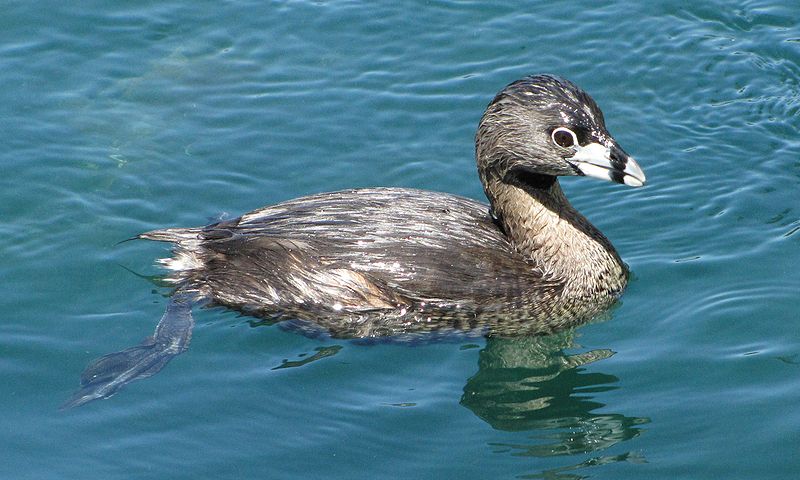
I had such an incident Monday night.  I was driving home from work and by a lake when a movement in the lake caught my eye.  I saw a two-toned short bill and slight head and a solitary bird.  A Pied-Billed Grebe.  Not my first Pied-Billed Grebe in the State or ever, but a good bird to get nonetheless and good addition to my Year list.  I often can't help but look around while I am doing other things.  I guess my saving grace is that while I look at birds, my dog enjoys lounging in the shade and my wife will always stop to look at plants, trees, and fungi.  Here's to many planned outings and the not planned ones as well!

File:PodilymbusPodiceps 6865.JPG
Pied-Billed Grebe by Davefoc

2013 Year List: 114 (86 to go!)
Pied Billed Grebe