Showing posts with label migration. Show all posts

Tuesday, May 20, 2014

An Ode to Photos of Warblers

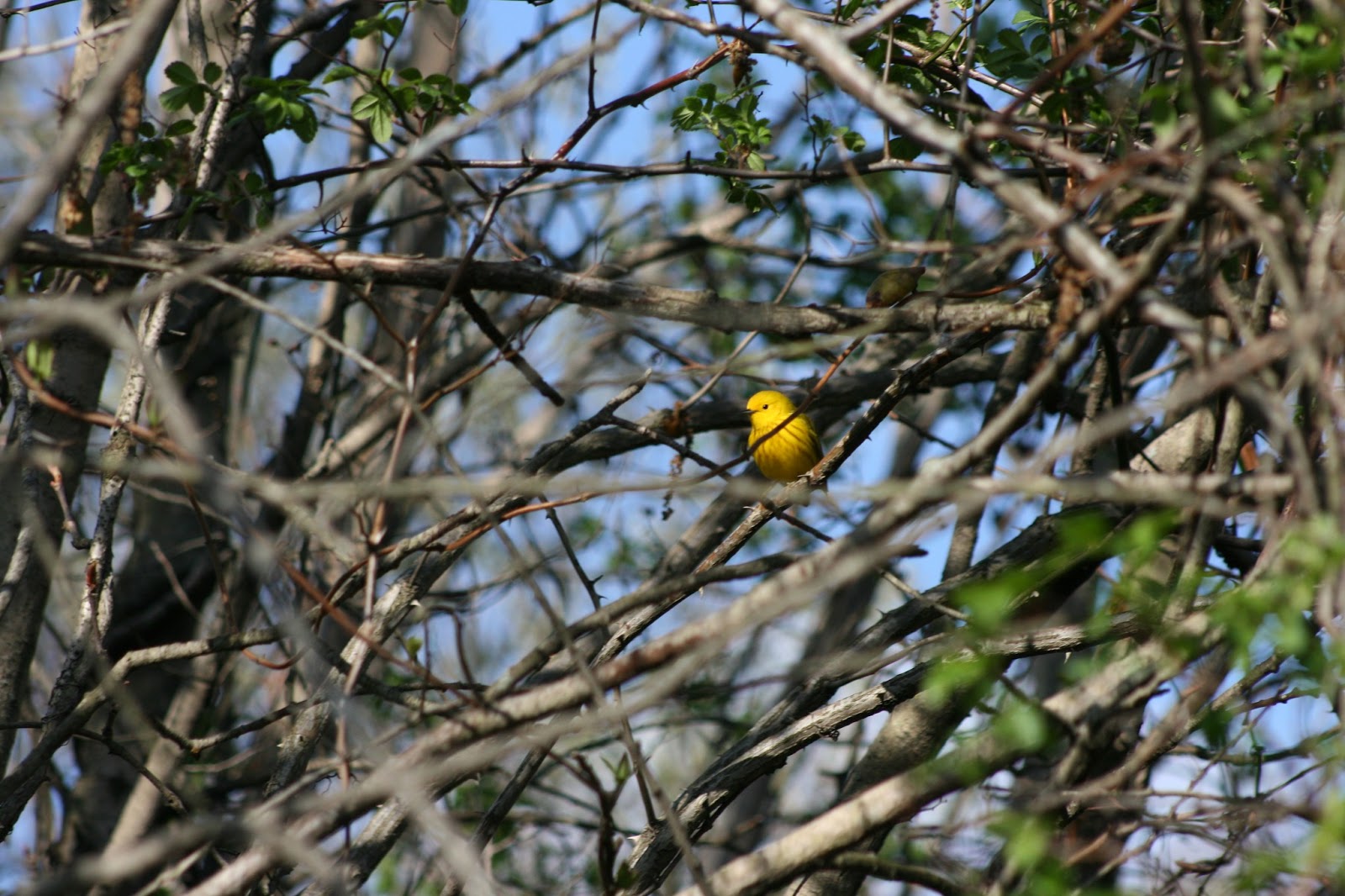
This is an ode to the thousands of photos I have to Warblers.  While I do have some that allow you to see the field marks, see the contrast of colors, and even enjoy the true beauty of the bird.  But sadly, those views can be rare and grabbing those pictures can be even rarer.  This is an ode to the difficult photos of warblers out there.  The Silouettes, the half shots, the partials wings, and tail views of birds fill my computer and external hard drive.

Why do most photos of warblers end up as partials or fragments of the birds they represent?  Well, warblers are tiny, fast, and often live at the tops of trees.  That means that good warbler pictures have to overcome those challenges.  Sometimes you can (and I will give you all some good pictures next time) but today is all about those pictures that drive us crazy.  So take a look, sympathize and let's move on and just enjoy the fact that we get to share some more time with warblers as they move on to their breeding grounds.  Until the next time warblers, go birding!

American Redstart

Backlight Bay-Breasted Warbler

Can you find the Cape May Warbler?

Linking to Wild Bird Wednesday - Link here

2014 Year Birds: 241 (9 to go!)
CT Year Birds: 225 (GOAL!)
Life List: 342 (58 to go!)

Tuesday, May 13, 2014

Accidental Big Day

So this past Weekend, I found myself doing something I had never done before.  After a productive stop at Bent of the River Audubon Center (link here) where I had over 50+ species of birds, I thought to myself after a friend mentioned it, if I could break 100 in a day.  Well, I tried and I did.  It wasn't a really planned big day and in fact, if i could do it all over again, I would structure my day a little differently.  But all that being said, I had a rather good day.  I've included my list and some photos from the day below.

Until the next time, get outside and go birding!

Brant
Canada Goose
Mallard
Green-winged Teal
Common Merganser
Wild Turkey
Common Loon
Double-crested Cormorant
Great Blue Heron
Great Egret
Osprey
Bald Eagle
American Oystercatcher
Black-bellied Plover
Semipalmated Plover
Piping Plover
Killdeer
Spotted Sandpiper
Solitary Sandpiper
Willet
Upland Sandpiper  FOY
Ruddy Turnstone
Dunlin
Least Sandpiper
Semipalmated Sandpiper
Short-billed Dowitcher
Ring-billed Gull
Herring Gull
Great Black-backed Gull
Least Tern
Common Tern
Rock Pigeon
Mourning Dove
Barred Owl
Chimney Swift
Ruby-throated Hummingbird
Belted Kingfisher
Red-bellied Woodpecker
Downy Woodpecker
Hairy Woodpecker
Northern Flicker
Willow Flycatcher  FOY
Eastern Phoebe
Great Crested Flycatcher  FOY
Eastern Kingbird
Blue-headed Vireo  FOY
Warbling Vireo
Red-eyed Vireo
Blue Jay
American Crow
Northern Rough-winged Swallow
Tree Swallow
Bank Swallow FOY
Barn Swallow
Cliff Swallow FOY
Black-capped Chickadee
Tufted Titmouse
White-breasted Nuthatch
House Wren
Carolina Wren
Eastern Bluebird
Wood Thrush
American Robin
Gray Catbird
Northern Mockingbird
European Starling
Ovenbird FOY
Worm-eating Warbler
Louisiana Waterthrush
Blue-winged Warbler
Black-and-white Warbler
Common Yellowthroat
Hooded Warbler FOY
American Redstart
Northern Parula
Magnolia Warbler FOY
Blackburnian Warbler FOY
Yellow Warbler
Black-throated Blue Warbler FOY
Yellow-rumped Warbler
Prairie Warbler FOY
Black-throated Green Warbler FOY
Canada Warbler FOY
Wilson's Warbler FOY
Chipping Sparrow
Field Sparrow
Savannah Sparrow
Grasshopper Sparrow FOY
Song Sparrow
Lincoln's Sparrow FOT
White-throated Sparrow
Northern Cardinal
Rose-breasted Grosbeak
Indigo Bunting FOY
Bobolink FOY
Red-winged Blackbird
Brown-headed Cowbird
Baltimore Oriole
American Goldfinch
House Sparrow

Canada Warbler, a first for CT for me

Short-Billed Dowitcher

Lincoln's Sparrow

Ovenbird

Bobolink, another CT first for me

Linking to Wild Bird Wednesday

Sunday, May 11, 2014

The Non-Warbler Special: Shorebirds

While warbler neck begins to strike the Birders of North America, other poor birds are ignored.  This tragedy can be reserved though.  Don't just look up, take some time and look down.  While walking a trail in a Connecticut Warbler Hotspot, I found a Solitary Sandpiper strutting around.  It was a great find for me in a park most noted for its warblers.

Its worth checking out a beach or two over the next few weeks.  Lots of birds will be using beaches to prepare for nesting and as staging grounds for migration.  They are important habitats for any number of species.  They are also hotly contested areas too.  Developers also see them as key habitats.  But that is a bit off topic.  Enjoy the Warblers and enjoy all the birds!

Happy Mothers Day and Go Birding!

Snowy Egret and a Yellowlegs!

Solitary Sandpiper

Silhouette of a Solitary Sandpiper

Tuesday, May 6, 2014

Spring-ing into Action

Spring is here, although some of the temps up here in the Northeast may fool you.  Birds are definitely moving through and some real rarities are popping up.  I dipped out on a Yellow-Throated Warbler that appeared at a local park but I am so excited to get all the great birds that are going to start moving through our state and across the continent.  With migration here, you should expect a lot more pictures of warblers on this blog, but I thought I would wrap up this post with a couple of useful tips for this migration season.

Know Your Habitat - Knowing what kind of habitat can help eliminate some species and help you figure out what to look for.

Know Your Trees - Similar to above, some birds like certain trees.  Knowing if you are looking at a cedar instead of a pine or a oak can help you eliminate one or two possibilities.

Listen First - Constantly listen as you walk.  Try to distinguish between the various calls and sounds you hear around you.

Check Flocks - If you know that the group of 6 Yellow-Rumps is just a group of Yellow-Rumps instead of just guessing, you are sure not to miss an odd bird.

Walk Light and Check the Trail Ahead - Don't go stomping like a mad person.  You will miss great views and sounds if you make a lot of noise.  You will even be able to catch some birds on the trail posing if you can be quiet enough.

More pictures coming soon!  In the meantime, get out and go birding!

Pine Warbler

Eastern Cottontail ... Warbler?

Blue-Grey Gnatcatcher

Next Time More Warblers!

Linking to Wild Bird Wednesday 

Tuesday, September 24, 2013

The Famous American Golden-Plover

Thanks to the movie, The Big Year (Link) the American Golden-Plover has gained an almost mythic status to new birders.  In the Movie, Jack Black shares a scene with his father over the epic migration of the Golden-Plover.  And indeed the Golden-Plover's migration covers almost all of the Americas as they move from Tundra to Southern Cone.  This migration, coupled with free movie stardom, has made people flock and wonder at the American Golden-Plover.

For the bird enthusiast, the Golden-Plovers migration is just the start.  For most of us, who don't live in the tundra or southern cone, the Golden-Plover is only a casual visitor to our locales.  Connecticut is no exception.  Although the past week has seen more than a few Golden-Plovers, they are still delightful birds and worth chasing.  When one was reported at Hammonasset Beach State Park, I had to go and chase it.  This young GP was so cooperative that it got within 10 feet of me and allowed me to take some great pictures.  I can't wait to go chasing this bird again and be witness to its migration!

All About Birds - The American Golden-Plover

American Golden-Plover in 

Looking for food in the open Fields

Can you find the American Golden-Plover

ID Challenge: What do you think it is?

Sunday, June 9, 2013

Migration in Review

With Warbler Migration season wearing down, I think back to my early days of birding.  One of the things my birding mentor said to me was that there was no such thing as a migration season.  Sadly, work has such thing as busy seasons and I am wrapping up the school year. I've been stuck in the classroom and after school meetings which has affected my ability to go out and catch migration.  Dipping is definitely frustrating but not even getting the chance to dip is equally, if not more, frustrating.

As Migration winds down, its time to look for shorebirds and nesting birds.  I am looking forward to looking for nesting birds and exploring the environment.  In the meantime, its time to hunt out shorebirds, late migrants, and scope out spots with nests.  Birds are certain;y active. I've run into territorial Carolina Wrens, Killdeer dragging their wings, and bespectacled American Robins!  I'll also be going on a couple of Pelagics and doing some book reviews.  What are people reading out there?  I am trying to build a summer birding reading list.

While I go out and hunt down some photos, enjoy some bird photos!

 Terns and Turnstones
A Collection of Gulls in New Hampshire
 Olive-Sided Flycatcher
A Skulking Yellow-Headed Blackbird


Sunday, May 19, 2013

San Antonio Review

So I just returned from a trip to lovely San Antonio Texas.  I visited 3 sites dedicated to birding.  I've already written about the good work being done at the Botanical Gardens.  So I want to focus on 2 other sites.  Warbler Woods (http://warblerwoods.org/) and Mitchell Lakes Audubon Center (http://mitchelllake.audubon.org/).  Both offer an incredible habitat for birds and all sorts of animals.  I had a blast exploring the different habitats around San Antonio and could have gone back for more.  There were countless sites that I want to go back to and see.

Warbler Woods - This site is incredible.  Painted Buntings, Greater Roadrunners, Scissor-Tailed Flycatcher, and Canada Warblers were the biggest highlights of the site.  For the followers of my blog, You will note that both Scissor-Tailed Flycatcher and Canada Warbler were 2 of my Goal Birds for the year.  It was a marvelous site and one that I hope to return to in the future!

Mitchell Lake Audubon Center - This site has a plethora of habitat and is great for shorebirds.  The pictures below are from this site.  My highlight of this spot were getting great shots of the Scissor-Tailed Flycatcher, a Spotted Sandpiper, and an American Golden-Plover.  This was super awesome for me!  A goal Bird, a nemesis bird, and just a beautiful bird!  Time spent at Mitchell  Lake won't be a waste.

This post is short so I can get back outside.  Why don't we all do the same!

 Scissor-Tailed Flycatcher
 Yellow-Headed Blackbird
 Wilson's Phalarope
 American Golden-Plover *Goal Bird*
Hudsonian Godwit

2013 Year List: 199 (1 to go)
Life List: 297 (3 to go!)
Eared Grebe LIFER
American White Pelican LIFER
American Golden-Plover LIFER and GOAL BIRD
Hudsonian Godwit LIFER
Western Sandpiper LIFER
Baird's Sandpiper LIFER
Stilt Sandpiper LIFER
Long-billed Dowitcher LIFER
Wilson's Phalarope LIFER
Franklin's Gull LIFER
Black-chinned Hummingbird LIFER
Curve-billed Thrasher LIFER
Yellow-headed Blackbird LIFER
Inca Dove LIFER
Black-bellied Whistling-Duck LIFER
Western Kingbird LIFER
Common Ground-Dove LIFER
Greater Roadrunner LIFER
Common Nighthawk LIFER and ABA Bird of the Year
Scissor-tailed Flycatcher LIFER and GOAL BIRD
Canada Warbler LIFER and GOAL BIRD
Painted Bunting LIFER
Lesser Goldfinch LIFER
Neotropic Cormorant LIFER
Cave Swallow LIFER
White-winged Dove LIFER

Thursday, May 9, 2013

Wood Thrush

Got my first wood thrush of the year.  It took a while because migration has been slow and I haven't had the chance to check out the spots where I got them in years before.  But while riding my bike the other day, i got one.  I recorded this sound of the Wood Thrush's call and once I put the camera, the wood Thrush actually flew out and was out in the open.  It is almost as if the bird knew I was filming him.  Almost. I don't have time for much more, but enjoy the video!


2013 Year List: 155 (45 to go!)
Wood Thrush

Monday, May 6, 2013

Birding in Central Park

Today we birded New York's Central Park.  Migration, in the Northeast, has been slow with just a few migrants here and there.  While the Day was slow it was a fun day in the park.  Lots of people were out and about.  Many people know that the Park is a completely artificial and manufactured environment.  It was designed to bring oxygen and natural life into New York City with hopes that oxygen and nature might civilize New York.  Many have written about the different parts of Central Park and the role it plays it for migrating birds, including me!

We entered the park with a goal of 20 birds.  I set a low bar because I was unfamiliar with the park and migration has been slow.  Long Story short, We were short 2 birds.  Part of the problem was that we only got 1 species of Warbler, a Yellow Warbler.  We did however manage to see Pale Male, a famous Red-Tailed Hawk Central Park Resident, and several nesting birds.  BC Chickadees, Blue Jays, and Robins were all in full swing with their nests.  It was a lovely day in the park and great to see tons of birders out!  I hope to get outside soon!

 Turtle Pond North of Belvedere Castle
 Pair of Mallards
A bit of the skyline feature the home of Pale Male, can you see it?

2013 Year List: 154
Bank Swallow

Saturday, May 4, 2013

Glossy Ibis

The Glossy Ibis.  Besides Birding, my other love is history and the Ibis is a historic bird.The Egyptians loved the Ibis and it formed part of their mythology.  Egrets and Hawks also did, but the Ibis has been found mummified and made into statues.  Many of the Ancient Peoples believed that Ibis and many birds held secrets as important as the origins of Civilization and life itself!  Ancient Egyptians believed that hawks were the first forms of life on the earth and believed that they held the secrets to the notions of Justice, Truth, and  Creation.  Pretty impressive and understandable.  Birds have mastered the sky, ground, and water and with such grace.

When I see the Glossy Ibis, I feel a part of that early Human tradition of appreciating and wondering about the birds before me.  What I need technology to do, move around the planet efficiently and quickly, find food/directions, and protect myself from the elements, birds seem to conquer on a daily basis.  The Hummers that show up the next few days will have braved a cross continental flight that we couldn't match in terms of speed and challenge.  The Glossy Ibis shape, color, and habits all have a mystery that we haven't mastered yet.  Perhaps one day, we'll know a little more!

Glossy Ibises
Glossy Ibises
Glossy Ibises
Great Egrets
A Nearby Killdeer

2013 Year List: 153
American Redstart
Black-Throated Green Warbler
Blue-Winged Warbler

Monday, April 29, 2013

Warblers, Warblers, and More Warblers

The massive migration of Warblers is underway.  Birds are showing up in our backyards from the Neotropic regions.  Its easy to just admire the bird once they show up and forget everything thing else facing that bird.   The migratory birds face shrinking environments, climate change, and the Human World.  These warblers overcome huge challenges to make it back to their breeding grounds.  Its important not to forget the perils of migration and the role they play in making their species healthy and successful.

Warblers don't tell this story themselves.  They just do what they do.  It is our responsibility not to make their voyage easier, but to respect their journey and to understand the role they play for our world.  Simple things matter a lot and simple choices can change a lot about our world.  There's an increasing awareness about bird-friendly coffee and that is something that I care a lot about.  I am working on a full post for that and hopefully it will be up soon.  In the meantime, look for new migrants outside!

 Black-and-White Warbler
Yellow Warbler

2013 Year List: 146
Black-and-White Warbler
Chimney Swift
Rose-breasted Grosbeak
Baltimore Oriole

Friday, April 26, 2013

First of the Year

When it comes to migration, there's a lot of pressure to see the first of the year.  To be the first to see something or record your first sighting of something.  Sometimes, these can be great moments.  The bird can be tired from their migration and just too hungry to really care who's around.  I saw my first House Wren of the season.  I was excited because it was the first of the year for me.  There's a lot of hype about the first of the year.  Everyone wants to see the first of the year birds and migration just makes the fervor even worse.  I don't want to sound self-righteous, I get caught up in the fervor.

Many write that birding is not unlike hunting.  The quest for the first of the year is indeed tied to the instinct to hunt.  Searching through the thicket, trees, and marshes, its a primal need and skill.  Being close to the earth in that way is amazing.  One of the main reasons I got into birding was to find a way to interact with nature beyond knowing the difference between a tree and a bush.  I wanted to understand something more about nature and certainly birding has changed the way I see my environs.

I will certainly keep looking for those FOYs.  I hope you do too!


What I was looking for...
Adult
(C) Gerry Dewaghe 
2013 Year List: 138 (62 Needed)
House Wren

Tuesday, April 23, 2013

Migration is Coming...

This is a a well known fact that spring is on its way.  Every day my phone lights up with bird alerts from around the state.  This makes for exciting outings.  Every time you go out, there's seems to be something new.  As the past week worked out, I saw all sorts of new birds and sights.  I've attached some pictures below from my travels.

I am hoping to get many more pictures of migrants as they pass through.  There are some impressive sights to be had.  At Bombay Hook, I have over 150 American Avocets.  Seeing Shorebirds move in and warblers move in really helps me to understand and appreciate the journey the birds make.  Migration is an amazing feat.  Well, enough writing and get outside!

Purple Martins
American Avocets
Blue-Winged Teal
Bass Spawning
Hermit Thrush
Carolina Wren

Friday, April 19, 2013

Birding with Legends

This week, I was birding with legends.  Well, Legend.  I drove down to the National Audubon Society Sanctuary at Mill Grove.  While a nice and very walk-able sanctuary, there is a hidden secret.  This site was Audubon's First home in the US.  You might call it the birthplace of American Birding, Conservation, and Environmentalism and there's definitely an argument to be made for that.  Audubon's prints and magnificent publication, The Birds of North America, has definitely changed the way Americans view their environment.  Its hard not to look at the book and its prints and find yourself getting lost in the blend of nature, science, and art and also realize how much our world has changed.  The center had up Audubon's prints of the Passenger Pigeon along with skins from the collections of local colleges.

Despite those changes, there are plenty of birds still around Mill Grove.  Carolina Chickadees, Cardinals, Hawks, Bluebirds, Swallows.  Its easy to see how a Young Audubon would have fallen in love with the natural world.  Also his future wife lived up the road so he would've had to climb through the grounds several times to see her.  But the variety of habitat makes this a great place to go birding.  There is a museum and exhibits about Audubon's life and work that is worth a visit as well.  Spending time following in Audubon's footsteps is a great way to reflect on the nature of birding and the future of birding, the environment, and conservation.

 A Northern Cardinal
 Eastern Bluebird
 Red-Tailed Hawk
Mill Grove

2013 Year List: 137 (63 to go!)
Forster's Tern (Lifer)
Black-Necked Stilt (Lifer)
Lesser Yellowlegs
Brown Thrasher
Purple Martin
American Avocet